

Why Export Packaging Matters
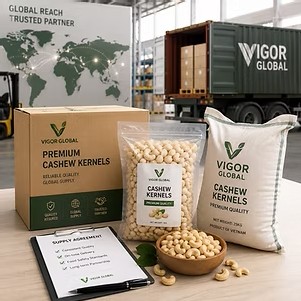
Preserving the quality of cashew kernels during long transit times—often spanning weeks across different climate zones—requires robust packaging standards. Cashews are highly susceptible to moisture absorption, oxidation, and physical breakage, making proper packaging a critical element of international trade.
Standard Export Packaging Formats
The global cashew trade primarily utilizes two main packaging formats to ensure product integrity from the processing facility in Vietnam to destinations in Europe, North America, or the Middle East:
1. Vacuum Packing (Flexi-Packaging)
This is the most modern and widely accepted packaging method. The cashews are placed inside high-barrier, multi-layer foil pouches. The air is evacuated (vacuumed), and often flushed with Carbon Dioxide (CO2) or Nitrogen before heat sealing.
- Weight: Typically 25 lbs (11.34 kg) or 50 lbs (22.68 kg) per carton.
- Advantages: The vacuum and inert gas environment prevents oxidation (rancidity), repels insects, and locks in the natural moisture level (Max 5%), extending the shelf life up to 24 months.
2. Tin Packing
A traditional method that is still preferred by specific markets, particularly in the Middle East.
- Weight: Generally 11.34 kg per tin, packed two tins per carton (22.68 kg total).
- Advantages: Tins provide absolute physical protection against breakage during rough handling and offer an impenetrable barrier to moisture and pests.
Carton Specifications and Palletization
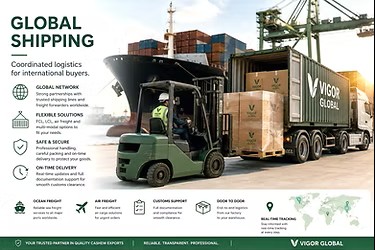
The secondary packaging is just as important. Export cartons must be constructed from heavy-duty, double-wall corrugated cardboard to withstand stacking pressure in shipping containers. Furthermore, proper palletization with shrink wrapping and edge protectors ensures that the cargo remains stable during sea freight, minimizing the risk of the ‘crushing effect’ on the bottom layers.
Compliance and Labeling
Export packaging must comply with the labeling requirements of the destination country, including clearly printed grades, origin, net weight, processing date, and lot numbers for complete traceability.
More Insights

Distributors & Importers
Stable export supply with flexible packaging and coordinated global logistics.