
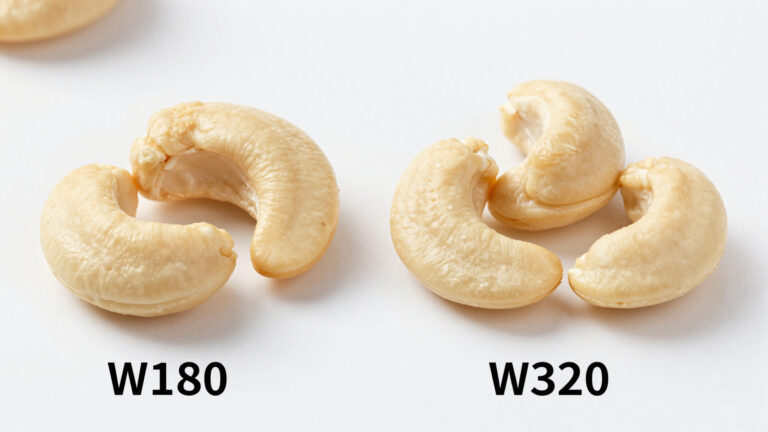
W180 vs W240 vs W320: Choosing the Right Grade for Your Market
Understanding kernel size, roasting performance, retail positioning, and industrial applications.
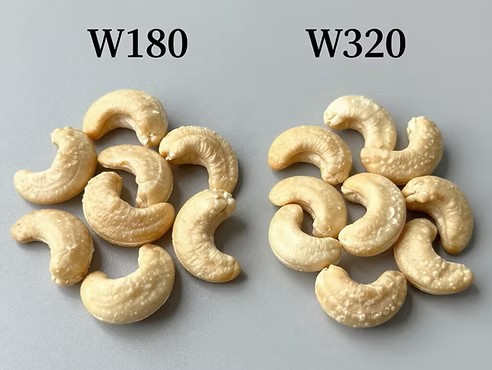
When purchasing cashews in bulk for import or distribution, the price-to-value ratio is the primary driver of decision-making. This article provides a deep dive into the commercial comparison between the premium W180 jumbo cashew and the commodity-standard W320.
The W320 grade is the benchmark for the global cashew trade. It represents the highest yield percentage from raw cashew nuts (RCN) during processing.
The W180 grade is rare, typically accounting for a very small percentage of a factory’s total yield. Consequently, its supply is limited, and its price is highly sensitive to crop quality.
A balanced commercial strategy involves maintaining a steady, high-volume supply of W320 to satisfy mass-market contracts while securing smaller, strategic volumes of W180 to service high-end retail clients and boost overall portfolio profitability.
Understanding kernel size, roasting performance, retail positioning, and industrial applications.